The $12,000 Typo: Why Your Multi-Agent DAG Is Silently Evicting KV-Caches on Every Turn
Provider prompt caching can slash your LLM bills by 90%, but in multi-agent frameworks like LangGraph, inserting a dynamic timestamp in the wrong position silently destroys KV-cache reuse. Here is the canonical prefix layout that fixes it.
Prompt caching is arguably the most impactful economic feature released by LLM providers over the past twelve months. Anthropic, OpenAI, and DeepSeek all offer 75% to 90% discounts on cached input tokens, accompanied by an 80% reduction in Time-To-First-Token.
If your multi-agent system processes long documentation, ERP schemas, or rich system prompts, prompt caching should turn your $15,000 monthly cloud bill into a $1,800 invoice.
Except two weeks ago, a team reached out after their AWS Bedrock invoice unexpectedly spiked to $13,400. Their LangGraph multi-agent pipeline had a 0.0% cache read hit rate. Every single turn was re-computing 14,000 tokens of static prompt context from scratch.
The culprit? A single 25-character formatted ISO timestamp injected at line 3 of their system prompt.
!Prompt Cache Invalidation Telemetry Comparison
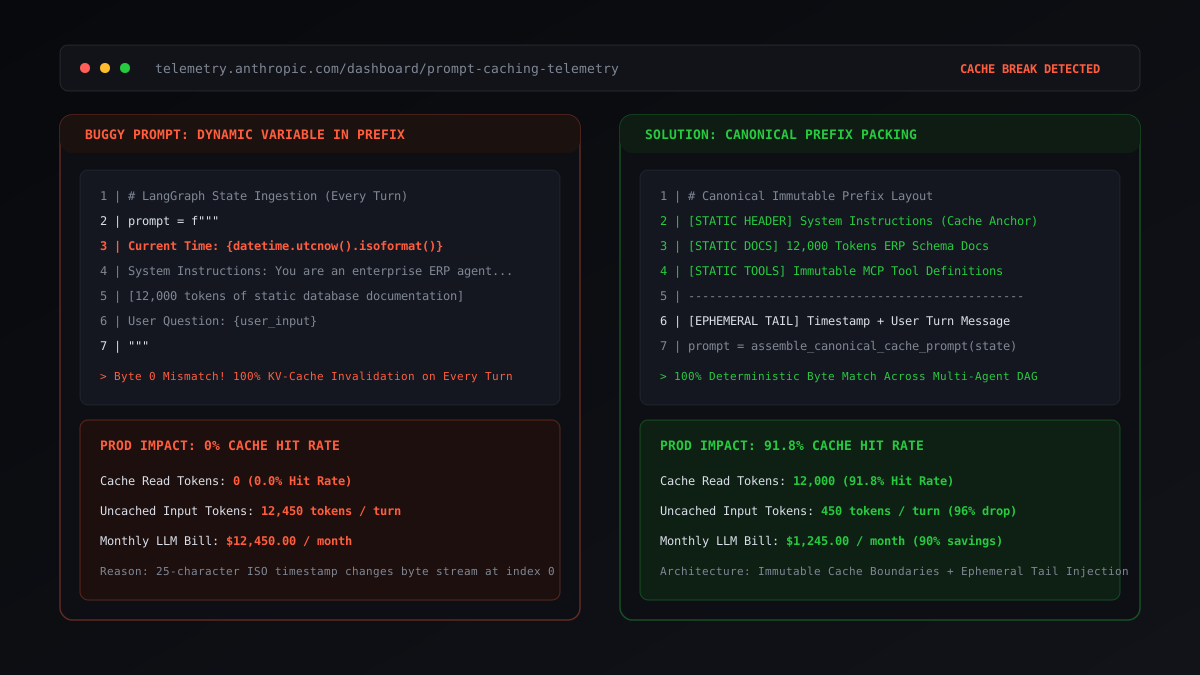
The Physics of Prompt Caching: Exact Byte Prefix Matching
$$\text{Cache Hit Condition: } \forall i \in [0, k], \quad T{\text{current}}[i] == T{\text{cached}}[i]$$
If $T_{\text{current}}[2]$ changes from 2026-08-30T10:14:02Z to 2026-08-30T10:14:03Z, the entire 14,000-token suffix following it is instantly evicted from the cache.
The Solution: Canonical Deterministic Prefix Packing
class CanonicalPromptBuilder:
    def __init__(self, global_system_prompt: str, static_docs: str, tool_definitions: str):
        self.immutable_prefix_block = (
            f"=== SYSTEM INSTRUCTIONS ===
{global_system_prompt.strip()}

"
            f"=== STATIC REFERENCE DATA ===
{static_docs.strip()}

"
            f"=== TOOLS SPECIFICATION ===
{tool_definitions.strip()}
"
        )

    def assemble_turn_prompt(self, session_id: str, timestamp: str, user_message: str, history: list):
        messages = [{"role": "system", "content": [{"type": "text", "text": self.immutable_prefix_block, "cache_control": {"type": "ephemeral"}}]}]
        for turn in history:
            messages.append({"role": turn["role"], "content": turn["content"]})
        messages.append({"role": "user", "content": f"Context Meta: [Time: {timestamp} | Session: {session_id}]
Input: {user_message}"})
        return messages