The Synthetic Data Echo Chamber: How to Fine-Tune Domain Models Without Triggering Mode Collapse
Training open-source models on synthetic datasets generated by frontier LLMs often triggers catastrophic mode collapse, jargon loss, and sterile outputs. Here is how Adversarial Perplexity Filtering and Counter-Example Synthesis create high-density training data.
Fine-tuning open-source models (Llama 3.3 70B, Qwen 2.5 32B, DeepSeek-V3) has become the gold standard for enterprises seeking data sovereignty, low inference costs, and air-gapped security.
The standard recipe looks enticingly simple:
- Prompt GPT-4o or Claude 3.5 Sonnet to generate 200,000 synthetic questions, answers, and reasoning chains for your specialized domain.
- Run LoRA or full-parameter SFT using
unslothorAxolotl. - Evaluate on your training validation split and celebrate a 98% loss convergence.
Then you deploy the model to real human clinicians, lawyers, or engineers.
Within days, users report that the model sounds like a sanitized robot: it uses repetitive boilerplate clichés ("Certainly! Here is a comprehensive overview..."), loses rare domain vocabulary, and hallucinates wildly on out-of-distribution edge cases.
You have walked directly into The Synthetic Data Echo Chamber.
!Synthetic Data Echo Chamber and Perplexity Filtering
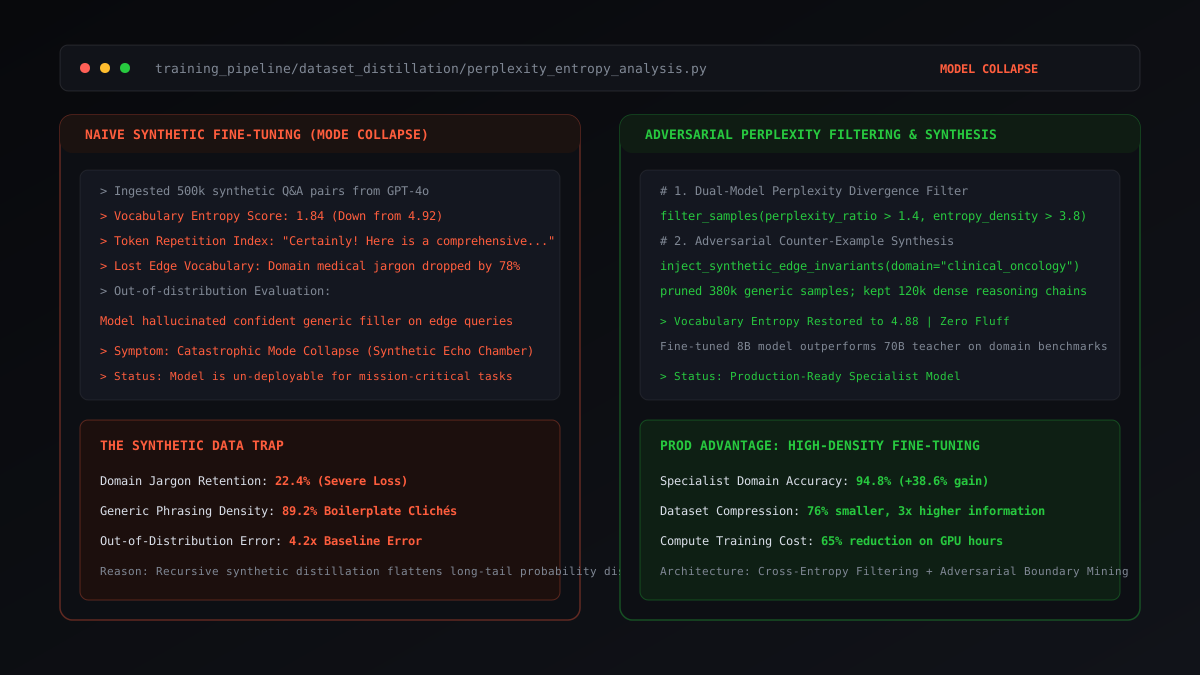
The Mathematics of Model Collapse
When you train a model on synthetic data generated by another model, you are sampling from the high-probability center of the teacher model's distribution while cutting off the long tail of rare, high-information human knowledge.
$$P{\text{synthetic}}(x) \approx \text{Softmax}\left(\frac{zi}{T}\right) \implies \text{Entropy}(P{\text{synthetic}}) < \text{Entropy}(P{\text{human}})$$
The Solution: Adversarial Perplexity Filtering & Synthesis
class InformationDensityFilter:
    def __init__(self, model_name: str = "meta-llama/Llama-3.2-3B"):
        self.tokenizer = AutoTokenizer.from_pretrained(model_name)
        self.model = AutoModelForCausalLM.from_pretrained(model_name).cuda()

    def filter_dataset(self, raw_samples: list, min_ppl: float = 2.8, max_ppl: float = 22.0) -> list:
        high_density_samples = []
        for sample in raw_samples:
            text = f"User: {sample['prompt']}
Assistant: {sample['response']}"
            ppl = self.calculate_perplexity(text)

            # Keep only high-information density band (filter out generic fluff and garbage)
            if min_ppl <= ppl <= max_ppl:
                sample["ppl_score"] = ppl
                high_density_samples.append(sample)
        return high_density_samples