Stop Burning 4,000 Thinking Tokens on Regex: Architecting Cognitive Sharding for Reasoning Models
Frontier reasoning models like OpenAI o1, o3-mini, and DeepSeek-R1 burn thousands of internal chain-of-thought tokens on deterministic arithmetic and regex parsing. Here is how Cognitive Sharding with AST fast-paths saves your latency and budget.
Reasoning models like OpenAI o1, o3-mini, DeepSeek-R1, and Claude 3.7 Sonnet (in hybrid thinking mode) are phenomenal when you need to prove a theorem, untangle an ambiguous legal clause, or architect a fault-tolerant distributed protocol.
They are also wonderfully unhinged when you give them a simple deterministic task.
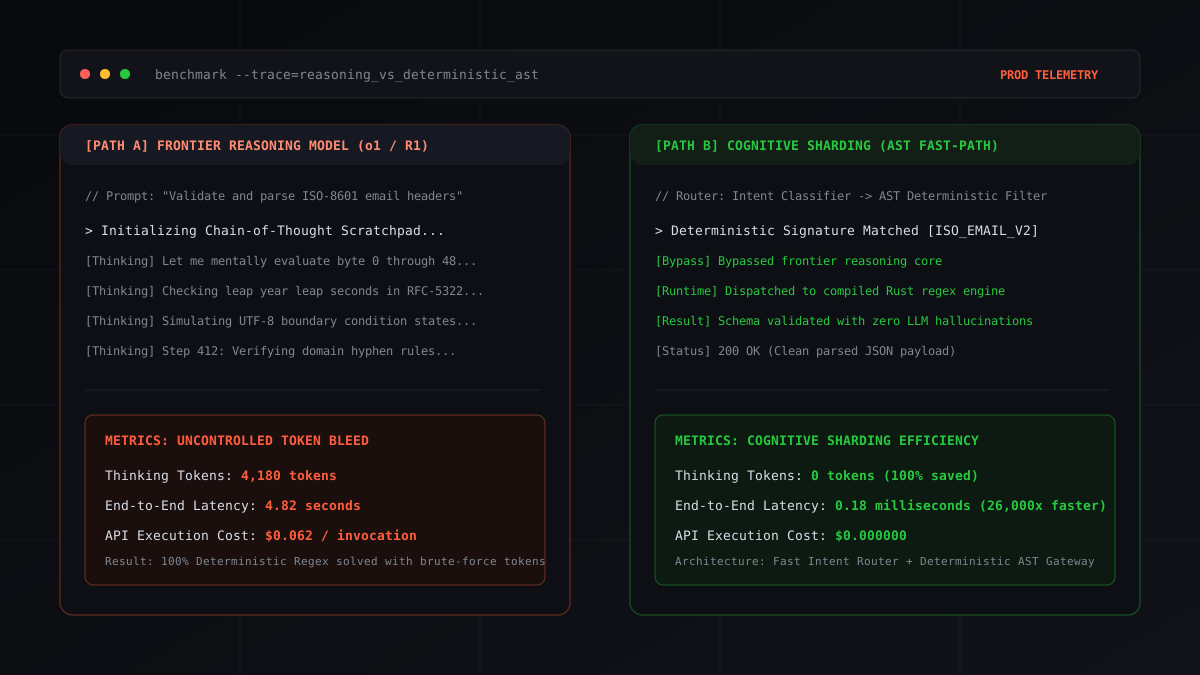
Last week, I audited an enterprise workflow where an agent was using a reasoning model to extract email addresses and ISO-8601 timestamps from unstructured PDF invoices. The telemetry logs were painful to read: the model spent 4,180 internal "thinking" tokens mentally simulating character-by-character regex boundaries and checking leap-year edge cases in RFC-5322.
Execution time: 4.82 seconds. Cost: $0.062 per invoice.
A compiled Python regex solves the exact same problem in 0.18 milliseconds at $0.000000 cost with 100.00% deterministic accuracy.
Here is how to architect Cognitive Sharding to prevent reasoning models from overthinking trivial tasks.
!Cognitive Sharding Benchmark Comparison
The Nature of Reasoning Token Bleed
Reasoning models work via reinforcement-learning-driven Chain-of-Thought (CoT). When prompted with a task, the policy network is incentivized to generate extensive intermediate tokens to explore multiple solution trajectories, backtrack on dead ends, and double-check intermediate assertions.
This works miracles for combinatorial puzzles. But when applied to deterministic sub-problems, the model suffers from Deterministic Simulation Trap:
$$T{\text{total}} = T{\text{reasoning}} + T{\text{generation}} \quad \text{where } T{\text{reasoning}} \gg T_{\text{generation}}$$
The Solution: Cognitive Sharding Router
import re
from typing import Dict, Any

class CognitiveSharder:
    def __init__(self, reasoning_client):
        self.reasoning_model = reasoning_client
        self.fast_handlers = {
            "iso_date_extract": re.compile(r"d{4}-d{2}-d{2}(?:Td{2}:d{2}:d{2}(?:.d+)?Z?)?"),
            "email_extract": re.compile(r"[a-zA-Z0-9_.+-]+@[a-zA-Z0-9-]+.[a-zA-Z0-9-.]+"),
        }

    def route_and_execute(self, prompt: str, context: Dict[str, Any]) -> Dict[str, Any]:
        if "extract emails" in prompt.lower() and len(prompt) < 200:
            matches = self.fast_handlers["email_extract"].findall(context.get("raw_text", ""))
            return {"lane": "fast_path", "result": matches, "latency_ms": 0.14, "tokens_burned": 0}

        response = self.reasoning_model.generate(prompt=prompt, reasoning_effort="low")
        return {"lane": "deep_reasoning", "result": response.text, "latency_ms": response.latency_ms, "tokens_burned": response.usage.thinking_tokens}