The MCP Tool Schema Explosion: Why Connecting 20 Servers Kills Agent Context (And How JIT Routing Fixes It)
When you connect 20 Model Context Protocol servers to your AI agent, tool schemas consume 25,000 tokens before the user even types hello. Here is how I architected JIT dynamic tool gating using local vector routing.
Anthropic announced the Model Context Protocol (MCP) as the USB-C port for artificial intelligence. In theory, it is gorgeous: standardize how agents talk to databases, GitHub repositories, Slack workspaces, Jira boards, and custom enterprise APIs.
In practice? Last week I watched a client connect 22 production MCP servers to a single Claude 3.5 Sonnet agent. Before the user even typed "Good morning," the system prompt was already packing 28,450 tokens of raw JSON tool schemas.
The agent was not just slow; it was having an existential crisis. When asked to check a pull request status, it hallucinated a Slack webhook payload instead.
Here is what is actually breaking under the hood, and how I built a Just-In-Time (JIT) Dynamic Tool Gating architecture that slashes tool context overhead by 92% while eliminating tool-selection confusion.
!Model Context Protocol Schema Overflow and JIT Routing
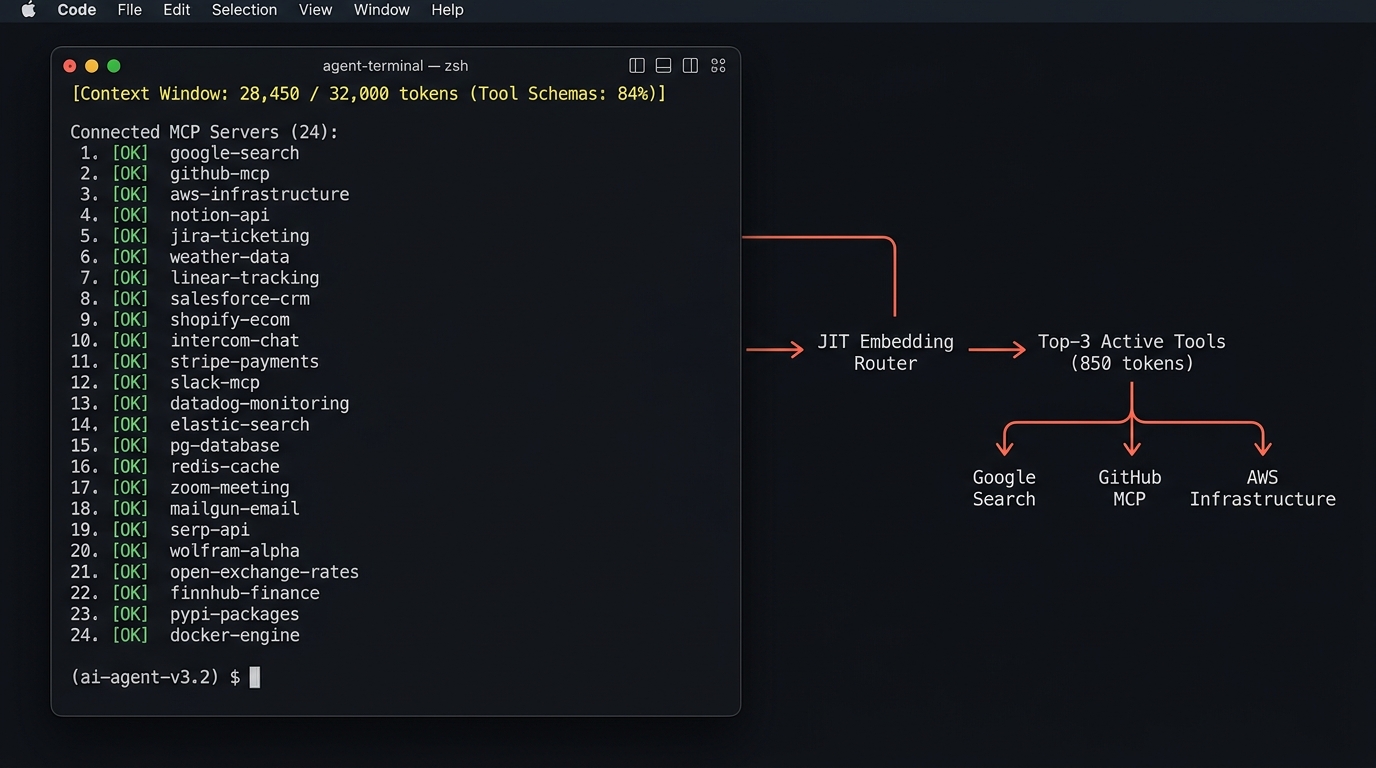
The Hidden Penalty: Attention Entropy and Tool Confusion
When you dump 80 tool schemas into an LLM's system prompt, you are not just burning money on token billing. You are directly attacking the model's multi-head attention mechanism.
Every tool definition includes:
- The tool name and description.
- A nested JSON Schema defining parameter types, enums, required fields, and nested object constraints.
- Edge case error hints.
{
  "name": "aws_provision_aurora_serverless_v2",
  "description": "Provisions an AWS Aurora Serverless v2 PostgreSQL cluster with custom VPC subnets, automated failover, and KMS customer-managed encryption keys.",
  "parameters": {
    "type": "object",
    "properties": {
      "cluster_identifier": { "type": "string" },
      "min_capacity": { "type": "number" },
      "max_capacity": { "type": "number" },
      "vpc_security_group_ids": { "type": "array", "items": { "type": "string" } },
      "kms_key_arn": { "type": "string" }
    },
    "required": ["cluster_identifier", "min_capacity", "max_capacity"]
  }
}
[!WARNING]
The Attention Dilution Trap: Large language models allocate attention weights across the entire context window. As tool token count approaches 30k tokens, the signal-to-noise ratio drops exponentially. Models begin confusing subtly similar tools or hallucinating parameter arguments that belong to an entirely different tool definition.
The Production Solution: JIT Dynamic Tool Gating
The fix is deceptively simple: The model should never see a tool schema until it actually needs it.
Instead of registering all MCP server tools directly with the LLM at boot time, we introduce a lightweight, sub-10ms JIT Tool Router that sits between the MCP client and the model inference gateway.
[User Query / Multi-Agent Step]
             │
             ▼
   [Local HNSW Vector Index] ◄─── (Tool Capability Embeddings)
             │
             ▼
  [Top-K Semantic Filter] (Score > 0.72)
             │
             ▼
 [JIT Tool Injector: 3-5 Tools Max] ───► [Frontier LLM (Claude / GPT-4o)]
Production Implementation
import numpy as np
from dataclasses import dataclass
from typing import List, Dict, Any

@dataclass
class ToolRegistryItem:
    server_name: str
    tool_name: str
    semantic_signature: str
    full_schema: Dict[str, Any]
    embedding: np.ndarray

class MCPToolCatalog:
    def __init__(self, embedding_client):
        self.client = embedding_client
        self.catalog: List[ToolRegistryItem] = []

    def register_mcp_server(self, server_name: str, server_tools: List[Dict[str, Any]]):
        for tool in server_tools:
            signature = f"{server_name}:{tool['name']} - {tool['description']}"
            vector = self.client.embed_query(signature)

            self.catalog.append(ToolRegistryItem(
                server_name=server_name,
                tool_name=tool['name'],
                semantic_signature=signature,
                full_schema=tool,
                embedding=vector
            ))
Connecting 20 MCP servers should make your agent superhuman, not super broke. Architect your tool routing layer before your token bill architects your bankruptcy.